Private Pilot Checkride in Arizona: 2026 Prep Guide
Published by
Blake Murphy
In This Article
The night before a checkride usually looks the same. A sectional chart is spread across the table, a line runs out of Mesa, and it bends around the Phoenix Class B airspace before it reaches the destination. The plan is finished, and what’s left is nerves.
Here’s the short answer to getting ready for your private pilot checkride in Arizona: learn the standard you’ll be graded against, get every endorsement and document in order early, and schedule around the heat. The checkride is the FAA practical test for your private pilot certificate. An examiner gives it, it opens with an oral exam and finishes with a flight, and almost nothing on it is secret. Below is each piece, plus the Arizona parts that students elsewhere never have to plan for.
Know the Standard You’ll Be Graded Against
Every private pilot checkride is built from one FAA document: the Private Pilot Airplane Airman Certification Standards, or ACS. You can download the current edition free from the FAA’s ACS page. Read it the way you’d read a test outline.
The ACS is organized into Areas of Operation, such as Preflight Preparation, Airport Operations, Takeoffs and Landings, Navigation, Slow Flight and Stalls, Basic Instrument Maneuvers, Emergency Operations, and Night Operations. Each area contains tasks, and each task lists three kinds of elements:
- Knowledge: what you need to know and explain
- Risk management: the hazards you need to recognize and how you’d handle them
- Skill: what you need to fly, and to what tolerance
The rules also say the test checks your sound judgment, which is where the risk management elements come in. An examiner wants to hear how you’d make a decision and then watch you make it. If you’ve followed our stage-by-stage guide to Part 61 training, you’ve already trained every item, and the ACS shows you how each one gets checked.
The Oral Comes First, Then the Airplane
Most checkrides start at a table. During the oral portion, the examiner asks about the knowledge and risk management elements: your airplane’s systems and limits, weather, airspace, regulations, performance, and the cross-country you planned. Expect a lot of “what would you do if” questions.
After that you go fly. The flight portion covers the skill elements: normal and crosswind takeoffs and landings, short-field and soft-field work, slow flight and stalls, steep turns, ground reference maneuvers, emergency procedures, and some flying by reference to instruments. Usually you’ll start the cross-country you planned, then the examiner will ask you to divert to a different airport partway through.
Here at Falcon Field, the flight starts the way your lessons did. You call Falcon Ground, read back your taxi instructions, and get cleared by Falcon Tower, with the examiner in the right seat this time. If radio work still makes you tense, our guide to radio communication at Falcon Field is worth reading again.
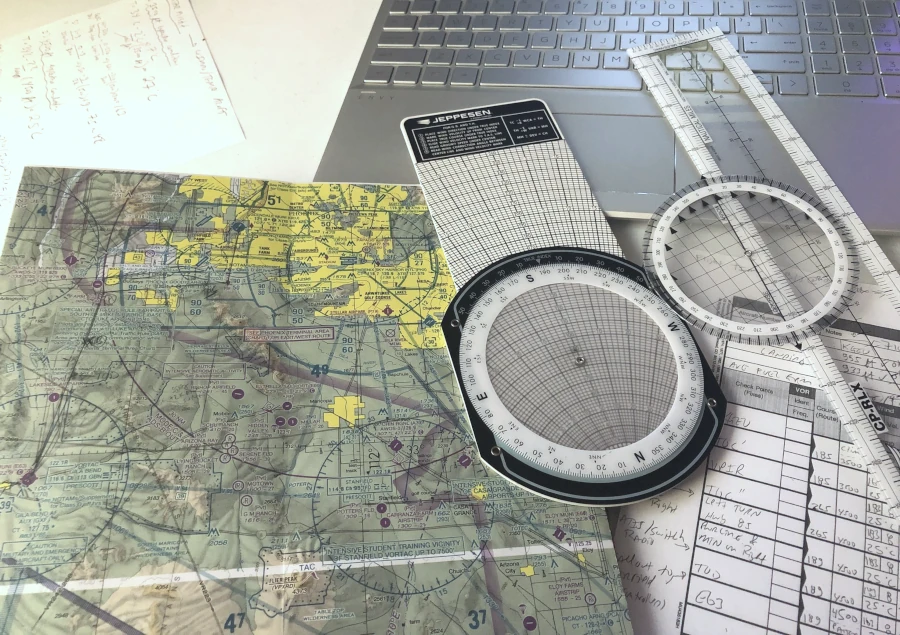
Your cross-country plan, charts, and navigation log open the oral.
The Endorsements and Paperwork That Get You In the Door
A checkride can end before it starts if one piece of paper is missing. The FAA sets the eligibility rules, so check every line before you book.
To take the private pilot practical test in an airplane, you need to:
- Be at least 17 years old and able to read, speak, write, and understand English
- Hold a student pilot certificate and at least a third-class medical (or qualify for BasicMed)
- Have passed the FAA knowledge test within the 24 calendar months before the month of your checkride
- Meet the aeronautical experience minimums, including 40 total hours
- Have logged 3 hours of checkride prep with an instructor within the 2 calendar months before the test
- Hold the instructor endorsements for ground training, flight training, and the practical test
That last endorsement says three things. You’ve trained within the past 2 calendar months, you’re prepared for the test, and you’ve reviewed the subjects you missed on the knowledge test. Your instructor recommends you when you meet the requirements and are ready. Our private pilot license requirements checklist covers when to start each item so none of them stalls you here.
You’ll also complete your application in IACRA, the FAA’s online certification system, and your instructor signs the recommendation there. Make sure your name reads the same on your IACRA application, student pilot certificate, and medical.
What to Bring on Checkride Day
Your examiner will send their own list, and that list wins. It usually looks something like this:
| Item | Why it matters |
|---|---|
| Photo ID | The examiner confirms who you are |
| Student pilot certificate and medical certificate | Proves eligibility |
| Knowledge test report | Required with your application |
| Logbook with all endorsements | Shows experience and the instructor’s sign-off |
| IACRA application login | The examiner works from it |
| Aircraft documents and maintenance records | Shows the airplane is airworthy |
| Your cross-country plan, charts, and weight and balance | Starts the oral |
You provide the airplane. The FAA requires an airworthy aircraft with the equipment needed for the test, and the examiner will look at its documents and maintenance records. Pull those records together with your instructor a few days ahead so nobody is searching for an inspection entry that morning.
Getting an Examiner on the Calendar
Your checkride is given by a Designated Pilot Examiner, or DPE. A DPE is an examiner the FAA appoints to give practical tests on its behalf. You can find DPEs with the FAA’s Designee Locator.
Examiner availability varies with location, demand, the aircraft, and each examiner’s authorizations. Calendars fill up, so start talking about a date before your last prep lesson. A knowledge test you haven’t passed yet can push the date back, because you need the test report to apply.
Budget for the fee as its own line. Plan on around $1,500 for the examiner’s fee, depending on the DPE. Our training cost estimator includes checkride and knowledge test fees, and our private pilot license cost guide shows how they fit into the total.
How Checkrides End Early, and What Happens Next
The rules spell out what happens on a bad day. If you fail any Area of Operation, you fail the practical test, and you can’t get the certificate until every area is passed. The examiner gives you a notice of disapproval.
A stopped checkride can also be a discontinuance. Either you or the examiner can end the test early for weather, an airworthiness problem, or any other safety-of-flight concern. You get a letter of discontinuance instead.
Either way, the next step is defined:
- After a failure, you need more training from an authorized instructor, who must find you proficient and endorse you before the retest.
- Credit for what you passed: finish the rest of the test within 60 days and you generally keep credit for the areas you already passed. You bring the notice or letter, any new endorsements, and a new signed application.
The checkrides that end early usually end for a reason you could see coming: a missing endorsement, an expired knowledge test, records that aren’t ready, or a maneuver that was shaky in training and never got fixed. Our post on common flight training mistakes covers the habits that lead there.
Plan Around Arizona Heat and Monsoon Season
Arizona adds two variables. The first is heat. On a hot afternoon, the airplane needs more runway and climbs more slowly, and the FAA’s advice is to fly the cooler hours when performance is in question. In summer, ask the examiner for a morning slot, and plan a 6:30 a.m. preflight while the ramp is still cool. Our post on how heat shapes Phoenix training explains the mechanism.
The second is monsoon season, which the National Weather Service counts from June 15 to September 30. Afternoon storms bring gusty outflow winds, blowing dust, and bumpy air. If the weather turns, a discontinuance protects the areas you already passed, so don’t push a marginal flight to save the date. Your personal minimums are part of the test too.
Build a Cross-Country Plan That Respects Phoenix Airspace
Cross-country flight planning is an ACS task, and Navigation covers pilotage and dead reckoning, navigation systems, diversion, and lost procedures. From Mesa, your plan has to account for the Phoenix Class B airspace around Sky Harbor, which shapes how you route out of the Valley.
Build the plan as if you’ll fly every leg. Mark checkpoints you can actually see from the air, pull the weather, and work the performance charts for the day’s temperature, not for a cool morning in January. Know where you’d go if you had to divert. Your VOR tracking and chart skills come together on the oral and in the airplane.
Your Final Weeks Before the Checkride
In the last few weeks you’re tightening skills you already have. This order works for most students:
- Read the ACS task by task and mark anything you can’t explain out loud.
- Review the questions you missed on the knowledge test, since your endorsement says you did.
- Fly your 3 hours of checkride prep and work your weakest maneuvers until they’re consistent.
- Run a mock oral with an instructor, ideally one who hasn’t flown with you.
- Plan a practice cross-country around the Class B and talk through a diversion.
- Check every document against the table above a week out.
Keep flying the whole time. Three to four flights a week keeps skills sharp, and most of our students finish the private in three to six months at that pace. If you’re new to our Private Pilot program, plan on a budget of $18,000 to $20,000. We don’t lend directly, but we work with Stratus Financial, Flight Training Finance, and AOPA Finance, and our financing page explains each one.
FAQ
How long does the private pilot checkride take?
It depends on the examiner, the weather, and how the oral goes. Leave the rest of that day open so you never feel rushed.
What is the ACS?
The Airman Certification Standards, the FAA document that lists every task on the test and how it’s graded. See the FAA’s ACS page.
Can I take the checkride in the summer?
Yes. Book a morning slot, and leave room in your plan for monsoon weather. Our heat guide explains why.
What happens if the weather turns during my checkride?
The test can be discontinued instead of failed. Finish the rest within 60 days and you keep credit for the areas you passed.
How much does the checkride cost?
Plan on around $1,500 for the examiner’s fee, depending on the DPE. The estimator shows it with your other costs.
Do I need to pass the written test first?
Yes. You must pass the FAA knowledge test within 24 calendar months before your checkride month. Our post on the written exam explains it.
Start the Path That Ends at Your Checkride
The checkride rewards students who fly consistently and prepare against the standard. If you’re ready to start or want to talk through where you are in training, contact us or call 480-256-8355, and we’ll help you build a plan that ends with a temporary certificate in your hand at Falcon Field.