Private Pilot License Requirements in Arizona: Your 2026 Checklist
Published by
Julie Hadley
In This Article
You can fly an airplane at SimpliFly long before you have a single FAA document. The paperwork starts to matter the week your instructor says you’re close to solo. We’ve watched students fly great lessons for a month, then sit on the ground waiting for a medical appointment or a student pilot certificate that nobody started. That wait costs you momentum, and at three or four flights a week, momentum is most of what you’re paying for.
Arizona doesn’t issue its own pilot license, so private pilot license requirements in Arizona are the FAA’s requirements. You need to be 17 to earn the certificate, read, speak, write, and understand English, hold a medical (usually third class), get a student pilot certificate before you solo, pass the FAA knowledge test, log the aeronautical experience in 14 CFR 61.109, and pass a checkride. Below, those items are in the order you’ll meet them.
Start With the Two Requirements You Already Have
Age and English are the gate the FAA checks first, and most readers clear them before they ever reach Falcon Field.
The age rules come in two steps. You must be at least 16 to get a student pilot certificate and fly solo in an airplane, and at least 17 to earn the private pilot certificate. You can start lessons younger than 16. Those hours count, so a high school student can build skills early and time the solo for a 16th birthday and the checkride for a 17th.
The FAA also requires that you read, speak, write, and understand English, and you’ll use all four early. You’ll talk to Falcon Tower on your first lessons, read checklists out loud, and answer an examiner’s questions in English on the checkride. If you’re new to aviation radio, our post on radio communication at Falcon Field walks through those first calls.
One small piece of paper goes with you on your first visit. Federal security rules require every flight school to verify U.S. citizenship before flight training starts, using government-issued documentation such as a U.S. passport. Students who aren’t U.S. citizens go through TSA approval first. Call our office before your discovery flight and we’ll tell you exactly what to bring.
Book Your Medical Before You Need It
A medical isn’t required to take lessons. It’s required before you solo, and most students reach that point sooner than they expect.
For student and private pilot privileges, the FAA requires at least a third-class medical certificate, issued by an Aviation Medical Examiner (AME), a doctor the FAA has authorized to do pilot exams. A higher class works too. You also need a valid medical on checkride day.
You may have heard about BasicMed, which lets some pilots fly with a driver’s license and a physician’s exam instead of an FAA medical. It only applies if you’ve held an FAA medical certificate at some point after July 14, 2006, so most first-time students start with a third-class medical. If you have a health question, talk to an AME before you book.
We cover the exam itself, the MedXPress form, and how long each class lasts in our guide to the FAA medical process. We ask every new student to schedule the exam in the first few weeks of training, so a deferral or a follow-up question doesn’t land on the same week as your solo.
Get Your Student Pilot Certificate Moving Early
The student pilot certificate is the FAA document that, with your instructor’s endorsements and your medical, lets you fly the airplane alone. You need it before your first solo.
You apply in IACRA, the FAA’s online application system for pilot certificates. You can start the application yourself, and your instructor helps you finish it in a short session at the front desk.
The FAA needs time to process the application, so we start it early in training, well before anyone is talking about a solo date. Once the medical and the student pilot certificate are both in hand, your first solo comes down to your flying and your instructor’s endorsement.
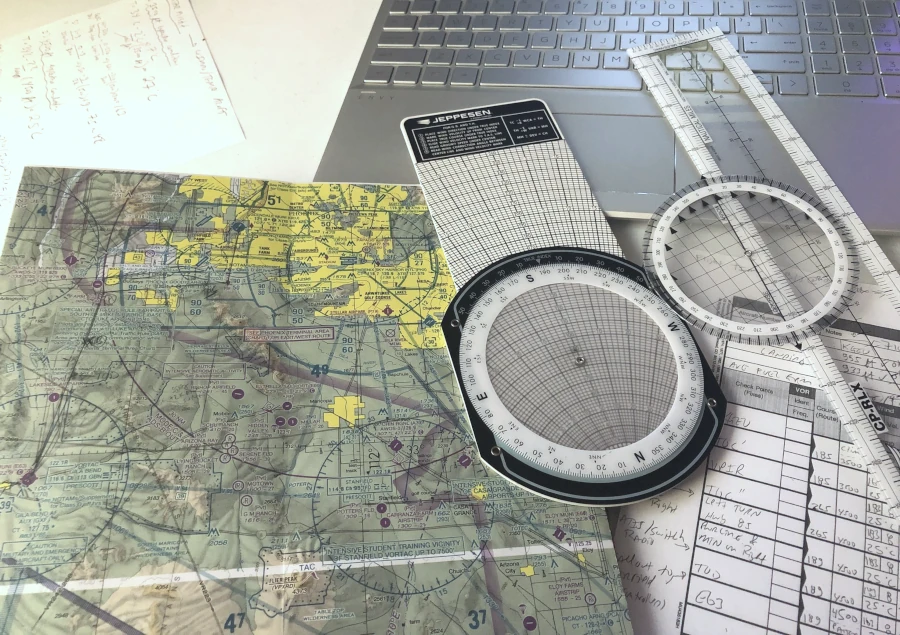
Knowledge test study and cross-country planning use the same tools.
Pass the Knowledge Test on a Clock You Control
The FAA knowledge test, often called the written, is a computer-based exam on regulations, weather, navigation, airspace, aerodynamics, and flight planning. Before you can take it, an authorized instructor has to endorse your logbook, confirming you completed the ground training or that they reviewed your home study.
One rule shapes when you take it. The knowledge test has to be passed within the 24 calendar months before the month of your checkride. That’s a generous window, but a student who takes the test early and then pauses training for a long stretch can watch it run out.
At three or four flights a week, the window rarely becomes a problem. The bigger risk is your flying getting ahead of your book knowledge. Our instructors help you study as you fly, so the cross-country planning you do in the airplane and the questions on the test reinforce each other. For what the exam covers and how to prepare, read our post on the written exam.

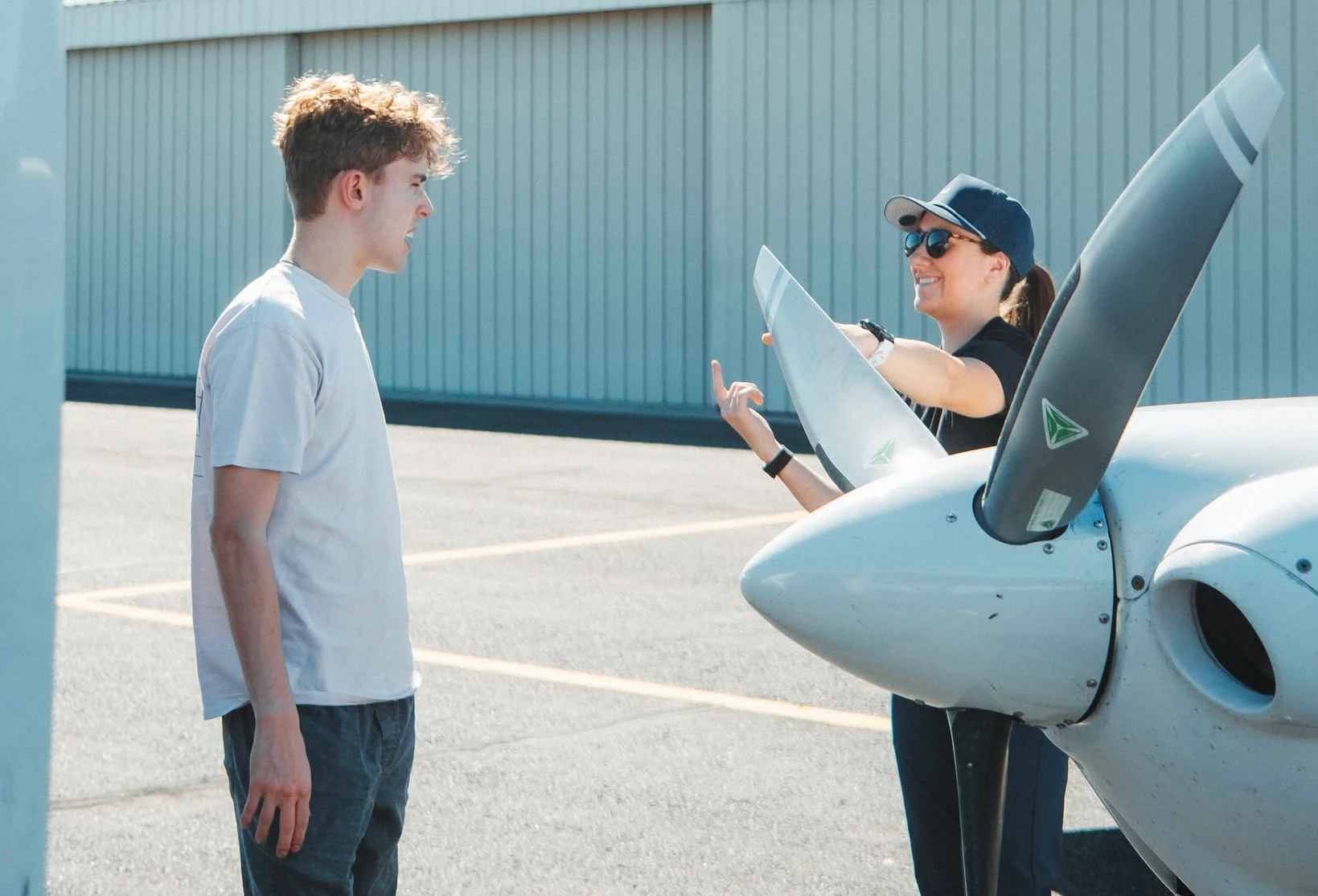
Every 61.109 line starts with a preflight on the ramp at Falcon Field.
Log the 61.109 Hours, Line by Line
Under 14 CFR 61.109, a private pilot applicant for an airplane single-engine rating must log at least 40 hours of flight time, including at least 20 hours of flight training with an instructor and 10 hours of solo flight. Inside those totals, specific experience has to appear in your logbook:
| Requirement | Minimum | What it looks like in training |
|---|---|---|
| Total flight time | 40 hours | Every lesson in your Private Pilot training adds to it |
| Flight training with an instructor | 20 hours | Dual lessons, from the first preflight to checkride prep |
| Cross-country flight training | 3 hours | Planned flights to other airports with your instructor |
| Night flight training | 3 hours, including one cross-country over 100 nautical miles total and 10 full-stop takeoffs and landings | Flying the Valley after dark |
| Flight by reference to instruments | 3 hours | Holding heading, altitude, and climbs with only the panel |
| Checkride preparation | 3 hours within the 2 calendar months before the test | Final dual lessons that polish every maneuver |
| Solo flight | 10 hours | You as pilot in command, alone |
| Solo cross-country | 5 hours | Flights you planned, flown alone |
| Long solo cross-country | 150 nautical miles total, full-stop landings at three points, one leg over 50 nautical miles straight-line | Usually the biggest day of private training |
| Towered-airport solo landings | 3 takeoffs and 3 full-stop landings at an airport with an operating control tower | Falcon Field has a tower, so this happens at home |
Forty hours is the FAA minimum. Most students log more before an instructor signs them off, because the sign-off comes when you fly to the standard. If you hear about Part 141 courses with a 35-hour minimum, that’s a different set of rules for FAA-approved school courses, and our post on choosing a Part 61 flight school explains the tradeoffs.
The towered-airport line is easy to meet at Falcon Field. Every pattern you fly at home already involves talking to a control tower, so the radio work is routine by the time you go solo.

The checkride is the last gate on the checklist.
Clear the Final Gate: Endorsements and the Checkride
When your logbook shows every 61.109 line, two more things stand between you and the certificate. Your instructor gives you a logbook endorsement that certifies you’re prepared for the practical test, and then you take the checkride with an FAA Designated Pilot Examiner (DPE), a pilot the FAA appoints to give the test.
The checkride has an oral portion on the ground and a flight portion in the airplane. You bring your logbook, your knowledge test report, your medical, your student pilot certificate, and an airworthy airplane. On checkride day, what counts is a recent endorsement, the 3 hours of prep inside the last 2 calendar months, and a logbook your instructor has already checked line by line.
Put the Checklist in the Right Order
Here’s the order we recommend to students who walk into our office at Falcon Field:
- Take a discovery flight to make sure flying is for you.
- Bring citizenship documentation so training can start.
- Book your third-class medical in the first few weeks.
- Start your IACRA application with your instructor.
- Study for the knowledge test alongside your flying.
- Fly toward each 61.109 line, then solo, cross-country, and night.
- Get your endorsement and schedule the checkride.
Most of our students finish the private in three to six months, depending on how often you fly, weather, and aircraft and instructor availability. Plan your budget around $18,000 to $20,000, and see the line items in our private pilot license cost breakdown. We don’t lend directly, but we work with Stratus Financial, Flight Training Finance, and AOPA Finance, and our financing page explains each option.
FAQ
Is there an Arizona state pilot license?
No. Pilot certificates come from the FAA, so the requirements are the same in Mesa as in any other state.
Can I start lessons before I have a medical?
Yes. You need the medical before you solo, not before your first lesson. Book it early anyway.
How old do I have to be to get a private pilot license?
Seventeen for the certificate and 16 to solo. You can start lessons younger.
Can I use BasicMed as a new student?
Only if you’ve held an FAA medical certificate at some point after July 14, 2006. Most new students start with a third-class medical.
Do I have to pass the knowledge test before I start flying?
No. You need an instructor’s endorsement to take it, and it has to be passed within 24 calendar months of your checkride month.
Will I finish in 40 hours?
Forty hours is the minimum the FAA requires. Most students log more, and your instructor signs you off when you fly to the standard.
Take the First Step at Falcon Field
A discovery flight puts you in the left seat of one of our Cessna 172s with an instructor for about 60 minutes in the air, and you fly most of it. Afterward, we’ll sit down with you, walk through this checklist, and help you get the medical and the student pilot certificate moving so the paperwork is never the reason you wait. Book your discovery flight and we’ll start your checklist together.